Sunday, February 3, 2013

Trip Report: Simien Hike

We were able to see all of the sights in Gondar in just one afternoon so the next morning we had some time to spare.  We joined our tour guide from the previous day and he got a driver to take us north of Gondar to the foothills of the Simien Mountains.  We drove a short distance (about 40 minutes), parked on the side of the road, and started hiking off into the mountains.


We totally had not expected to have this opportunity so we were really excited to be getting to do this.  We hiked for a couple of hours, taking in spectacular scenery.  The pictures are nice, but they simply don't capture the beauty that surrounded us.


We had our guide, a scout and a guard hiking along with us.  From a high vantage point they spotted gelada baboons in the distance.  We headed in that direction and would stop periodically to take photos and watch them from our improved proximity.  Then we would hike a little closer.  Abebe kept telling us we were as close as we would go.  Then he would say "okay, let's go a little closer."


There were about 30 baboons in the group that we were watching.  We were close enough to see little babies jumping around and playing, and the adults showing their patterned chests.  Eventually the baboons started to move along and so we headed back.  We hiked for about 2.5 hours altogether and had a fantastic time.  As we neared the road we were joined by several kids that tagged along, congregating around Christie and holding her hands.  We were invited into the home of a woman that lived near the road.  She gave us each a glass of an alcoholic beverage made from sorghum.  We tried to decline since we don't like alcohol and everyone assured us it had not fermented long so there wasn't much alcohol.  It sure tasted strong though and we ended up giving our nearly full glasses to our guide when it was time to leave.


Saturday, February 2, 2013

Trip Report: Gondar

We awoke early and took a flight from Lalibela to Gondar, stopping briefly in Axum.  Gondar is known as the "Camelot of Africa" thanks to a conglomeration of medieval castles that resemble those of Europe.  You can see the castle theme throughout town.  Even the airport has the appearance of a castle.  When we got to our hotel it was about lunch time.  After a snack lunch, we headed out to explore the sights.  The castle complex was just a short walk from our hotel.  We paid admission and got a guide, Abebe, who was our most memorable of the trip.  He told us all about the history of Gondar and its role as the 3rd major capital of Ethiopia (after Axum and Lalibela). 


The castles were built in succession by several different rulers in the 1700s, following the style of other castles built by Portuguese Jesuit missionaries.  The complex is now a UNESCO World Heritage Site, just like the churches of Lalibela.  The main castle is still intact and in very good condition.  Many of the other castles and buildings were bombed by Britain during World War II in an attempt to expel the Italian invaders.  There are some really neat features to the castles, including a system of guttering leading to an underground cistern and a steam house.  Other buildings on the grounds include stables and lion cages.


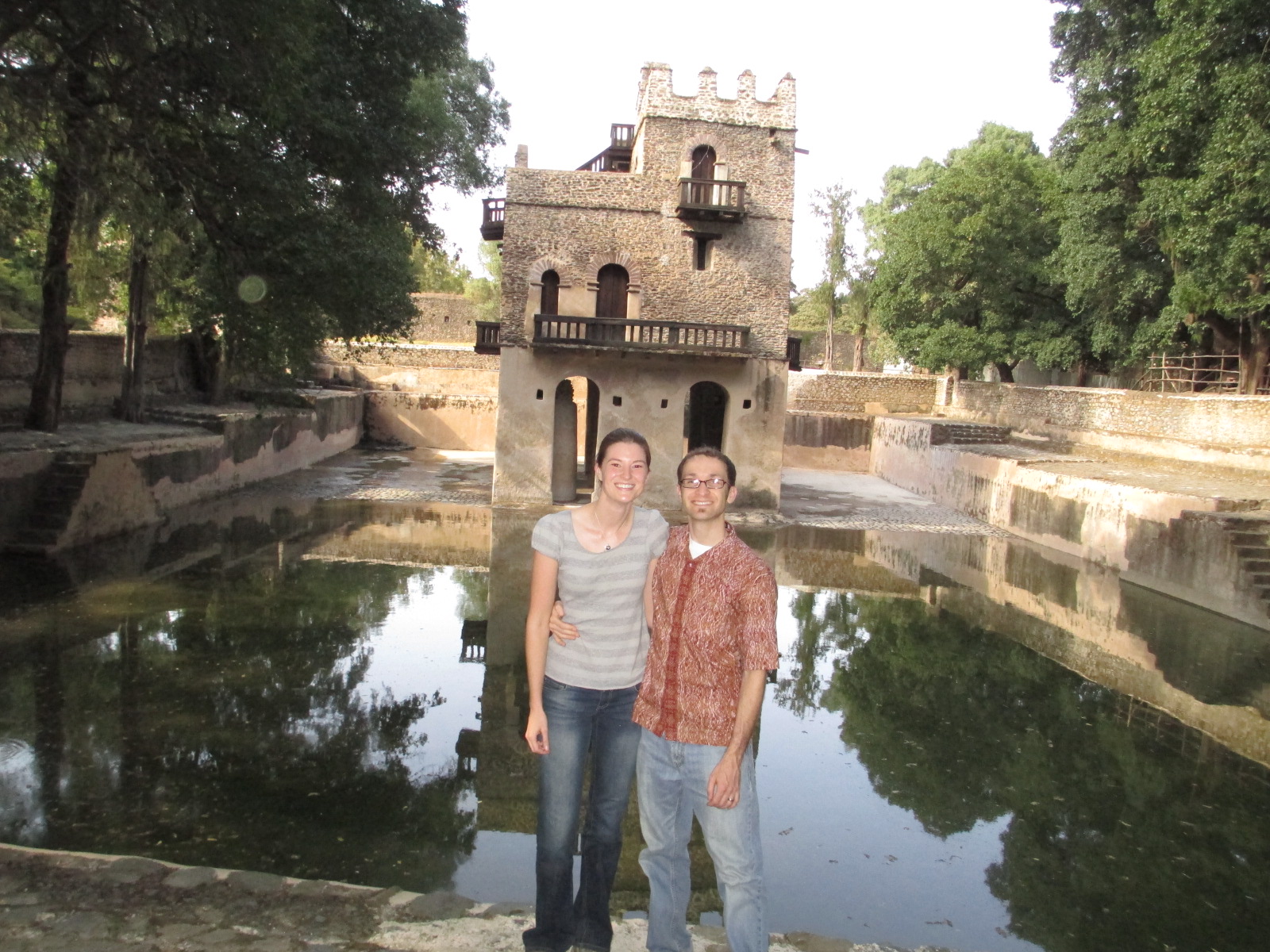
Our admission also included access to Fasilidas's Bath.  This is a large pool with a castle/residence in the middle.  There is some debate about the original purpose of this pool.  Our tour guide told us that it was primarily for recreation for the royal family.  Now, the pool has become the venue for an annual celebration at Timket.  Timket is the Ethiopian Orthodox celebration of Epiphany, the time when Jesus was baptised in the Jordan River.  Every year on January 19 hundreds of Ethiopians travel to Gondar and come to this location to witness as priests bless the water.  Then everyone jumps in for a renewal of their baptism.  We were in Gondar just 2 weeks before Timket and they were beginning to fill the pool.  It takes about a month to fill and then it is drained about a week after the Timket celebration and is dry the rest of the year.


We hopped in a bajaj and rode over to the Debre Birhan Selassie church, famous for the ceiling painted with hundreds of angels.  The church is not large, but a good percentage of the Bible is represented in paintings covering the walls inside.  Abebe showed us each paiting and explained the stories to us.  It was really great to see this in person after having seen pictures of this ceiling so many times.


We finished our sightseeing for the day and headed back to the hotel where we got to enjoy a New Years Eve party with traditional Ethiopian music and dancing.  We were sitting right in front and had a great view of the action.


Tuesday, January 29, 2013

Trip Report: Lalibela

On Sunday morning we departed Addis Ababa early in the morning for a flight to Lalibela!  We could hardly contain our excitement.  Over the last three years we have been soaking up as much information as we could about Ethiopia and we have been planning this trip, hoping that when the time came we would be able to organize travel outside of Addis.  We were finally in Ethiopia and headed to the town of rock-hewn churches!


We took a short flight on Ethiopian Airlines and spent the whole flight looking out the windows.  When we arrived in Lalibela we were amazed at our surroundings.  We were really in the mountains, and there was nothing around us.


The van ride from the airport to the town of Lalibela was incredible.  All along the way there were children running up to the road, waving at us while we whizzed by at a speed that could only be considered comfortable by those who drive this road regularly.  Our drive took us higher and higher in elevation until we were finally winding through some populated areas and arriving in Lalibela.


We got to our hotel and quickly arranged for our tours for the day.  We had enough time to visit half the churches before the noon to 2 pm lunch period when the churches are closed.  Then we visited the other half of the churches after lunch.


The Bet Medhane Alem church is home to the very special Lalibela processional cross.  This cross used to be displayed on a regular basis, but it was stolen in 1997.  It was later returned and now it is guarded more closely and only shown off by a priest on Sundays.  We just happened to be visiting the church as the priest was showing the cross and blessing people with it.


The churches of Lalibela were carved with simple tools in the 12th century.  The goal was to create a "New Jerusalem" so that Orthodox Ethiopian Christians would not have to make pilgrimages all the way to Israel.  It just so happened that we were in Lalibela one week before the Ethiopian Christmas (Genna).  Pilgrims from all over Ethiopia were already arriving on foot.  Many of these people were from rural parts of Ethiopia, so they were seeing white skin for the first time when we passed each other.


All of the churches were beautiful.  Some were intricately carved on the exterior and others were intricately carved on the interior.


When it came down to it, there was really no question about which church was our favorite, though.  Saint Giyorgis is by far the most picturesque and memorable.  We approached the church from a hillside above and were looking down on the top, which is shaped like a cross.  It is tall and slender with a very small footprint on the inside.  It has weathered very well due to the drainage system and gutters that are set up from its roof, all original to the church.


The sides glow lime green in the sunlight from the lichen that has grown on the reddish brown rock.  It is just amazing to know that each of these churches are one solid piece of rock, carved from the top down.  The interiors are hollowed out, one chisel and chip at a time.  The intricacy of the work is just astounding.


After we finished touring the churches we took the long hike back through town to our hotel.  Along the way we talked with many locals.  There were two high school boys, Dejen and Tomas, who told us about how they are temporarily living in Lalibela in order to go to school.  Their family lives out in the countryside where there aren't any schools.  They work part of the day in order to make enough money to pay some rent and then go to school the other part of the day.  Their accommodations are very modest - a stick and mud house with a grass roof.  In the rainy season, the roof leaks and their few belongings inside the house get drenched.  In typical Ethiopian hospitality, Dejen and Tomas invited us to join them for a coffee ceremony in their home.  It was really a highlight of our trip, being invited into the home of two young men who were delighted to spend a couple of hours visiting with us.  They have access to a computer at their high school, so we are keeping in touch through email.


Our hotel was very nice and had a gorgeous panoramic view of the surrounding mountains and countryside.  Our journey out of Addis was off to a great start!


Monday, January 28, 2013

Trip Report: Kuriftu Resort

After spending the week in Addis we headed south on Saturday to the Kuriftu Resort, near Debre Zeit.  The resort is located on the shores of a small crater lake.  The drive to the resort was highly trafficked, not the leisurely ride through the countryside that we had been expecting.  Nevertheless, we were getting to see our first sights outside of the city and we even spotted a herd of camels!


The Kuriftu Resort is really peaceful.  We purchased a fairly inexpensive day pass for lunch and kayaking.  We spent quite a while out on the kayak, rowing around the perimeter of the lake and finding a shady spot to watch all of the colorful birds fly past us. We really tried to get good photos of these super colorful Kingfishers, but they are quick and elusive.


There was a nice buffet meal with some Ethiopian food and some western food.  They had a really good, creamy lasagna.


After lunch we sat on these sunbeds for a couple of hours and just chilled while we caught up in our trip journals. It was very relaxing.


Saturday, January 26, 2013

Trip Report: Addis Ababa

On our court trip we spent 5 days in Addis before leaving the capital to explore other parts of the country.  Then we came back to Addis for another 2 days.  We really enjoyed our time in Addis and outside of the city.  The people in Ethiopia are very friendly and enjoy talking to foreigners - especially the children.  We learned a small amount of Amharic (about 50 words and phrases) before going on the trip so we were able to exchange pleasantries and ask where the bathroom is, etc.  People would really get excited when we would speak a bit of Amharic with them.  Then they would say "You know Amarigna?" and we would have to answer "tinish" (just a little), so they didn't assume we were fluent and say a lot of things we couldn't understand.  During our time in Addis we were able to visit the main sites: Holy Trinity Church, Lion Zoo, Addis Ababa University and Ethnological Museum, National Museum, and Entoto Mountain, including Menelik's Palace and St. Mary's church.

The Ethnological Museum was really neat and is located in the former palace of Emperor Haile Selassie on what is now the campus of Addis Ababa University.  The focus of the museum is the diversity of the tribes found in Ethiopia.  It also includes the bedroom and bathroom of the emperor and some very nice religious art on the top floor.


The National Museum includes ancient cultural artifacts and relics from the old empire on the main floor, art work on the upper floor and the archaeological finds on the basement level.  This is where Lucy, Ardi and Selam are on display.  They are the oldest known hominids and it is really amazing to get to see their castings in the country where they were discovered.


The Lion Zoo is small and needs a facelift, but we were fortunate to see the lions eating their big slabs of raw meat for lunch and walking around their pens.  These lions are the black-maned Abysinnian lions that have been kept for centuries by the kings of Ethiopia.  The zoo also has a couple of gelada baboons, vervet monkeys, duikers, antelope, turtles and birds.  Christie loved the tiny duikers!


The structure of the Holy Trinity Church is much like you would see in Europe, but with pieces of Ethiopian history mixed into the paintings and other decorations.  It is large and towering with stained glass windows and pews set up facing the alter.  This is not the normal shape or set up of the Ethiopian Orthodox Churches.

We drove up the side of Entoto Mountain, which is covered in Eucalyptus trees.  At the top of Entoto is St. Mary's church, which is the traditional octagonal shape, but brightly painted in blue, yellow, green and red.  There is a great view out over the city, but through a camera lens you can barely see the horizon for the smog.  There is a small museum next to the church where a tour guide will explain the interesting items from the beginning of Addis.  The guide will then walk you through the buildings around the church, including Menelik's Palace and the first church of Addis Ababa, built in 1877.


 We visited other places suggested by Gladney: Yod Abyssinia Cultural Restaurant, Sabahar Silk Factory, Alert Hospital, Kechene Girls Home, Kolfe Boys Home, and Kebebe Tsehai orphanage.
The Silk Factory was a lot of fun, because you could see the process from start (silk worms) to finish (beautiful scarves).  The weavers were really friendly and were obviously proud of the work they were doing.


The Hilawe Children's Home is the new facility that Gladney has partnered with.  We went there to visit two children that have been matched to Gladney families.  We were really impressed with the building and the care the children were receiving.  The place was clean and the staff very friendly.  Families that have children at Hilawe should be comforted knowing that their kiddos are in good care until they get to come home to their forever families.


We also managed to visit lots of different eateries: Antica, Island Breeze, Avanti, East Dragon Chinese, Kaldis, Top View, Tabla Indian restaurant, Arcoboleno, and Lucy's.  I think our favorite meals in Addis were the pizza at Island Breeze, the delicious pasta dishes at Avanti, and our milkshakes at Kaldis.  We visited each of these places more than once.  We got to share a couple of meals with other traveling Gladney families, Kim and Jeff, and Jean and Robert.  We also got to have a meal with our friend Nahom who is Ethiopian, but hadn't been back to Ethiopia in 3.5 years until this Christmas.